Samaritans and Sinlaku
Outsiders and insiders after the Typhoon

May 20, 2026
The “Office of Insular Affairs” sounds farcical, like a Ministry of Silly Walks.
As is fitting with a place so shaped by unintended history, the little known and idiosyncratic Office of Insular Affairs is the primary Federal agency responsible for governance of the Commonwealth. The title is doubly ironic. “Insular affair” to modern ears implies an extramarital dalliance that is also somehow aloof and withdrawn. Further, this sliver of bureaucracy, descended from the office created by the War Department to handle the far-flung territories acquired in 1898 after the Spanish-American War, is now in the Department of the Interior. After our 27-hour travel day to return to the mainland for a few weeks, the Northern Marianas could not seem less like it belongs to anything approaching our nation’s ‘Interior.’
‘Insular’ just literally means ‘island.’ Anyone who has spent time on an island can see why the modern meaning - isolated, withdrawn, inscrutable to outsiders - has developed from the original latin geographic name.
And ‘island’ is used for the idea of standing alone, without help or reliance on others. Darrelle Revis’s ability to shutdown the best opponent receiver in man-to-man coverage in the secondary made wherever he happened to be known as “Revis Island.” English lawyer and metaphysical poet John Donne in 1624 used the image in his most famous poem:
No man is an island,
Entire of itself.
Each is a piece of the continent,
A part of the main.
If a clod be washed away by the sea,
Europe is the less.
As well as if a promontory were.
As well as if a manor of thine own
Or of thine friend’s were.
Each man’s death diminishes me,
For I am involved in mankind.
Therefore, send not to know
For whom the bell tolls,
It tolls for thee.
Islands are famously concerned with who belongs. In Come from Away, a musical about the Newfoundlanders suddenly hosting to stranded 9/11 travelers, the ones who are stuck there verses from there is paramount. The new Apple TV dark comedy Widows Bay is about a Martha’s Vineyard-type place whose natives can never leave.
Almost everything from Ireland is primarily focused on what and who belongs to Ireland. Cultural discourse even in places supposedly under the broader aspirations of the United States — Puerto Rico, American Samoa, Hawaii, and Guam— is constantly focused on who is of the island and what that means for their rights and responsibilities.
I don’t know of a place more actively engaged in that debate than Saipan. I have been a participant in and subject of it since arrival. And, so as the storm cleared and survival moved to recovery, I watched closely. People of Northern Marianas Descent have a different package of rights than everyone else. There are vestiges of a pre-contact caste system alive and well. Some activists from one recognized indigenous group consider the other to be interlopers. Haole (like myself) are tolerated, but can never truly lose the status. A person’s lineage can be litigated in court.
Given all of this, I found it particularly interesting that one of the first groups to arrive on island was called Samaritan’s Purse. If there could be a more on-the-nose demonstration about how help should be expected and provided regardless of status, I don’t know it.
Founded in 1970, they are the largest evangelical missionary international organization on Earth. They are run by Franklin Graham, the son of Billy Graham. Pacific islands are a particularly missionary-riddled place,1 and, given my life experiences, my inclination is to skepticism. When the figurehead is Franklin Graham, I am doubly skeptical.
The first thing I thought about was the name. I was quite familiar with the content of the Parable of the Good Samaritan:
“A man was going down from Jerusalem to Jericho, when he was attacked by robbers. They stripped him of his clothes, beat him and went away, leaving him half dead. A priest happened to be going down the same road, and when he saw the man, he passed by on the other side. So too, a Levite, when he came to the place and saw him, passed by on the other side. But a Samaritan, as he traveled, came where the man was; and when he saw him, he took pity on him. He went to him and bandaged his wounds, pouring on oil and wine. Then he put the man on his own donkey, brought him to an inn and took care of him. The next day he took out two denarii and gave them to the innkeeper. ‘Look after him,’ he said, ‘and when I return, I will reimburse you for any extra expense you may have.’” (Luke 10: 30-35)
I have lost count of the times I have heard this story explained. A priest, who had a professional and moral obligation to the Jewish traveler. The Levite is a fellow Isrealite, with at least a countryman and coreligionist’s connection to the man. The Samaritan, however, was not an Israelite. Though Samaria was the name of a place that was also located in the area under Roman administration that is now the modern nation of Israel, the Samaritans were not the same people as the Jews.2
The idea of a ‘Good Samaritan’ has leapt from its gospel origins. A ‘Good Samaritan’ law is one where a bystander who renders aid is shielded from civil or criminal liability. Seinfeld’s final episode was about a fictitious law requiring a bystander to step in by the same name. The meaning has become 'someone who helps despite not having a duty to do so.’
Thee frame narrative around the parable is significant. Jesus is not vague about why he is telling that story at that particular time. It is his illustration for the clarifying question asked by one of those obnoxious people obsessed with definitions, hoping to do what is required and no more: Lawyers.
25 On one occasion an expert in the law stood up to test Jesus. “Teacher,” he asked, “what must I do to inherit eternal life?”
26 “What is written in the Law?” he replied. “How do you read it?”
27 He answered, “‘Love the Lord your God with all your heart and with all your soul and with all your strength and with all your mind’; and, ‘Love your neighbor as yourself.’”
28 “You have answered correctly,” Jesus replied. “Do this and you will live.”
29 But he wanted to justify himself, so he asked Jesus, “And who is my neighbor?”
After the story, in Socratic fashion, Jesus asks the lawyer that asked him:
36 “Which of these three do you think was a neighbor to the man who fell into the hands of robbers?”
37 The expert in the law replied, “The one who had mercy on him.”
Jesus told him, “Go and do likewise.”
Most of the oldest international civil-society organizations had roots in ecclesiastical charity. The Salvation Army proseytizes, but most donors probably associate the organization with its thrift stores and bell-ringers. The Red Cross has become secularized, and is known as Red Crescent and Red Star when the image of outsiders bearing a cross into a land with a rather-well justified sense memory of people rolling in under the symbol of the cross.
But this is the exact type of organization that can move most quickly, most nimbly.
On our return legs from Saipan to Guam and Guam to Tokyo, the airplanes were larger and newer than normal. And they were chock-full of aid workers leaving. After two weeks, the scope of the disaster and what would be needed for recovery was only beginning to be tolled.
We sat next to an Aggie who lives in Boone North Carolina and works for Samaritan’s Purse. He was highly complimentary of how quickly the recovery had begun compared to some of the other places that he has deployed. Self-reliance and communitarian principles are traits that islanders take seriously as part of their identity generally and the Marianas specifically.
We heard the same thing from John, a Memphian in the Army Corps of Engineers hoping to make it back to his 36-week-pregnant wife after a sudden deployment to assist the Utilities Corporation get its power plants up and running.
It is a peculiar place to be where American defense and civil agencies come to help, but the organizations associated with third-world refugee crises also are on the ground.
America has not always belonged to everyone, though I do like to think that most of the people would like us to live up to that aspiration, just as most adherents to Christianity would like to think that acting ‘Christianlike’ is the standard, despite the many times it has been missed. I don’t think that I am the only one who has become more jaded in recent years at how much America actually does aspire to live up to those, or if we just liked the sound of the poem we put on the statue about huddled masses yearning to breathe free.
It is supposed to be a club that anyone can join. This is harder in a place where the American project came to its shores instead of people traveling to America to seek it out.
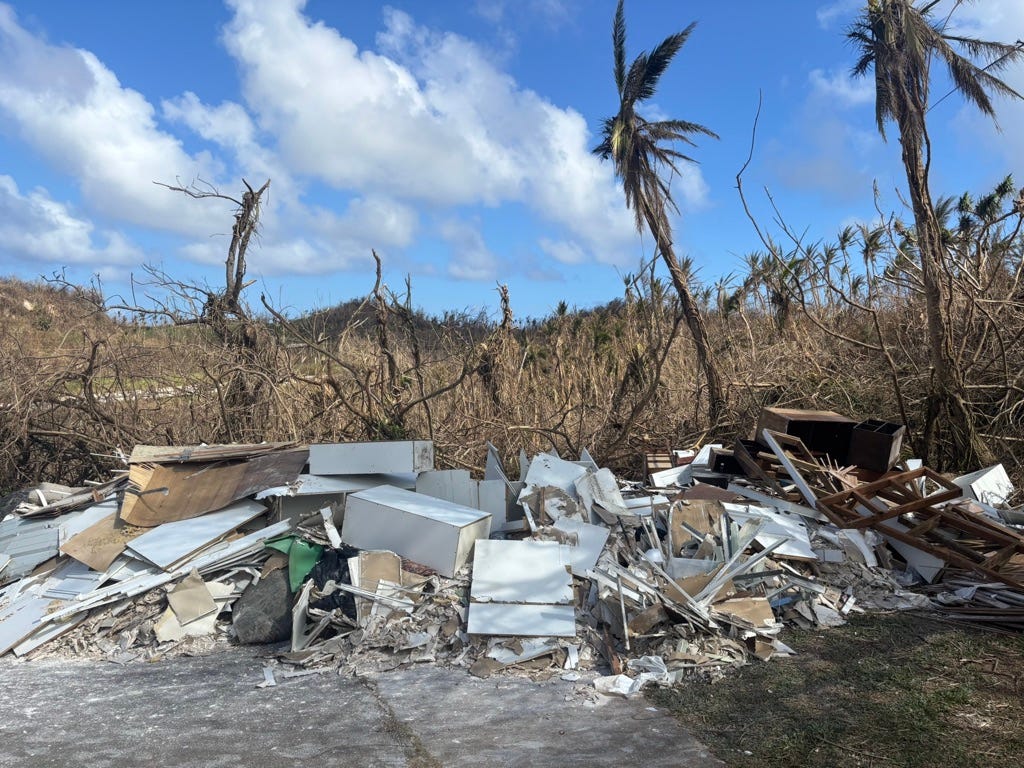
But things like Sinlaku always raise the question about this idea of ‘taking care of our own.’ And regardless what the political debates have been, when the need was there, the answer to ‘who is my neighbor?’ at least in Sinlaku, at least on Saipan, has been a resounding “Everyone.”
A Thai family restaurant contributed food and partnered with World Central Kitchen to deliver thousands of meals.
A White veterinary student who has adopted Saipan raised money from the Pacific Northwest to fill in the gaps from the government response.
A Chinese national who has helped make the island feel like home to hundreds of people in her ten years on island orchestrated relief efforts for those that the normal channels have overlooked, regardless of who they are.
Midwestern veterans from Team Rubicon arrived to do health checks door-to-door.
42 Californian firefighters arrived to clear what had become a massive tinderbox.
Shipping containers from the diaspora - communities typically quite poor - have been sent from five different states.
Our frenemy Guam has sent material and engineers from their own utility to help us.
I hope that, when we do recover that we reflect on these and hundreds of other stories still playing out, there is a bit more recognition that, though the history and paths that have brought all of the communities and individuals into this unique place have often been tumultuous and tragic, the island is a place that is loved and considered home to more than just the people whose ancestors are from there.
The history that had Samaritans and Jews sharing the place governed by the far off mightiest power in the world was messy. The animosity between the communities flared up. There were ugly aspects across the board. But it is exactly that scenario that Jesus used to illustrate the very core teaching of the faith that so many ascribe to: Love your neighbor. And your neighbor is not always who you expect.
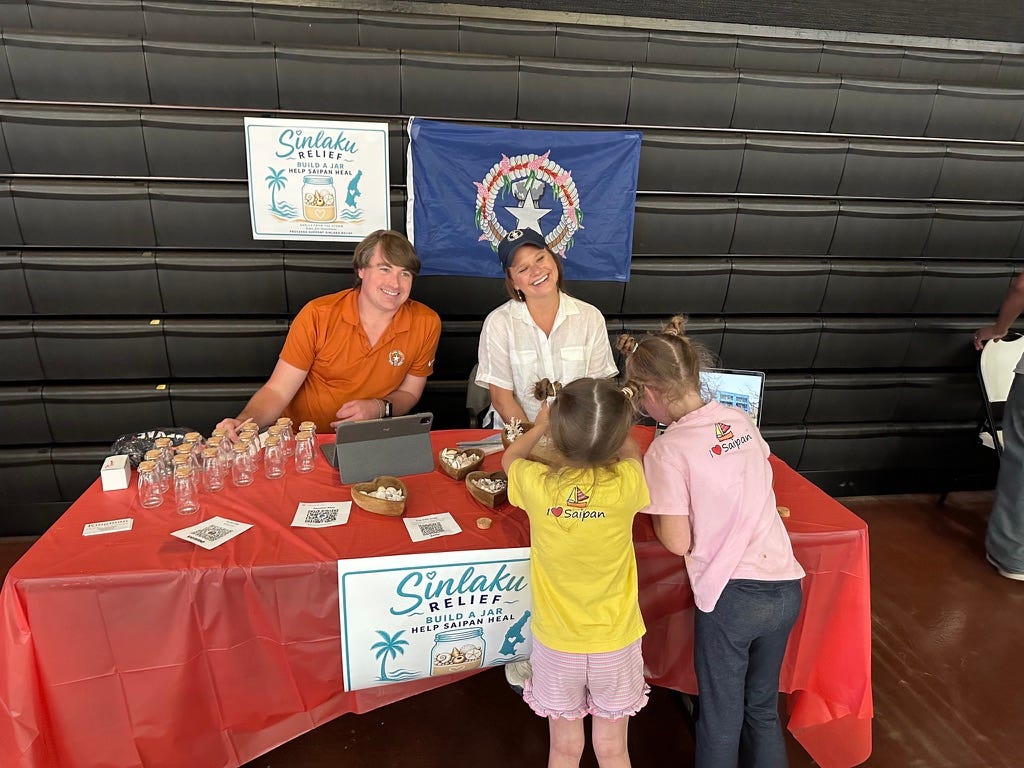
How you can help:
If you have ever seen on the news a disaster site and thought ‘I need to help,’ now is the time. For many reasons, the Federal response will not be as strong, generous, swift, or competent as it normally is.
Spread the word:
This post is public so feel free to share it.
Supplies:
If you would like to send care packages - we need power banks and batteries, especially ones with a solar component. Even places with generators only have them for a few hours to charge lights, phones, and whatever refrigeration they can get. There is no telling when we will get clean water, so purification devices - filters, tablets, etc. - are excellent.
It is always hot here. Without power for the small air-cons that are in most homes, cross-wind is the only way to keep cool inside. But with the displaced environment, the staggering amount of standing water, and the culling of the bird population, the bugs are about to get bad. Anything along the lines of mosquito netting or bug-spray can help.
We have a lot of dry goods stocked here for food - spam after all is a staple here precisely because it is shelf-stable - but the butane powered stoves are in short supply.
Mold, even in the mostly concrete buildings here - gets bad very quickly and will get worse as the air is stable. Cleaning supplies would be helpful.
But people will need to replace basics for hygiene: diapers, baby wipes, first aid kits, and portable camp showers.
I will make sure they get where they need if you send them to me at:
1 Chalan Kanoa Vlg #502592 Suite 2101 - Saipan, MP 96950
Money:
If you are in a position to contribute financially, here are some organizations that I vouch for that will not misspend the money:
Karidat is a long-established local Catholic social-services organization that serves everyone.
Micronesia Climate Change Alliance is leading up a lot of the local recovery and disaster mitigation efforts. After only sporadic typhoons for centuries, the NMI has had three Supertyphoons in 11 years. Regardless of the politics around anthropogenic climate change, these islands are going to face a disproportionate impact despite having contributed literally nothing to the carbon crisis.
Annie and a pair of my friends are helping with World Central Kitchen , which feeds people in disasters better than any other operation.
The Saipan Humane Society is doing the best it can for an island with no veterinarian, a different relationship to dogs and cats than in the mainland, and the absolute overrunning of animals. Many of our community dogs are looking rough. The pregnant animals often drop their litters and flee during the high-stress of storms like this. We have a huge influx of helpless litters.
500 Sails is an incredible organization restoring the almost-lost indigenous navigation and sailing tradition. They are close to the Carolinian community, where many of the habitations are less-secure and thus more-destroyed than most on island. They also lost their roof, and the damage to the canoes - unique works of science and art - is still unknown.
A site to serve as a hub for information and resources, Marianas Strong, is a resource for what the needs are on the ground.
The Marianas are, indeed, strong. But we are also Americans. We serve as an outpost in the second island chain. We often feel forgotten and neglected. And we are not perfect. But we need help.
Perhaps it is not merely Pacific islands. In my freshman year of high school, I went on my only mission trip. I went with my Southern Baptist church youth group to Prince Edward Island, spreading the gospel to the godless heathens of rural Canada. We brought a multi-racial Christian ska band with us. Clearly the setting of ‘Anne of Green Gables’ was a den of iniquity and devilry in desperate need of redemption.
ahem.
Great piece 🙏🤙🏽